Several serious medical conditions can result from an unhealthy gut, including inflammation and microbiome dysbiosis (imbalance). A healthy gut is the product of numerous biochemical processes that maintain homeostasis so the body can rid itself of ‘unhealthy’ microorganisms while keeping those necessary for proper bodily function. Key factors in gut health, and consequently human well-being, are the more abstract chemical concepts of redox balance, and its unhealthy counterpart, oxidative stress (a consequence of chemical imbalance).
In the body, numerous chemical reactions are constantly taking place that involve the exchange of electrons between molecules. In a healthy gut, the transfer of electrons between molecules is said to be in a state of redox balance: one molecule is oxidised (loss of electrons) while another is reduced (gain of electrons). A state of oxidative stress occurs when this balance is altered, leading to an unhealthy gut microbiome. During oxidative stress, dangerous and highly reactive molecules are produced, known as reactive species, including those known as reactive oxygen species (ROS). It is worth noting that ROS do have a physiological function in cells as messenger molecules (e.g., in apoptosis), but their elevated production can be harmful. An excess of ROS causes damage to lipids, proteins, and DNA, potentially leading to several pathologies.
Until recently, it was not possible to measure the level of reactive species throughout the human gastrointestinal (GI) tract. Read on to learn about the new technological developments that have allowed scientists to generate a profile of what a healthy gut’s reactive species profile looks like. These findings may have a significant impact on future gut disease monitoring and treatment strategies.
Development and validation of a miniaturised ingestible oxidation–reduction potential sensor capsule
Currently available clinical tools to study the human GI tract are far from perfect. To begin with, most of the devices used to study these complex, inaccessible cavities are invasive (e.g., during colonoscopy or endoscopy). Patients must endure unpleasant bowel preparations that alter the gut environment. Also, the devices do not access the entire length of the GItract.
At present, more conventional procedures lack specific oxidative stress sensors. In this context, the measurement of oxidative stress in humans is limited to faecal analysis, which yields unsatisfactory results, likely due to the highly reactive nature of oxidants and the impact of environmental oxygen. Therefore, oxidative stress is only measured indirectly by quantifying the damage it causes to DNA, lipids and proteins, but failing to capture the dynamic nature of redox balance along the tract.
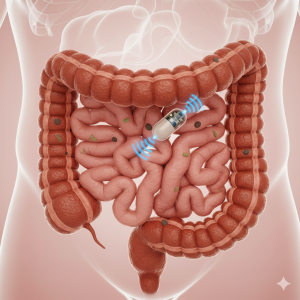
Measurements of redox balance are possible using oxidation-reduction potential (ORP) sensors. Positive ORP values indicate oxidising environments, while negative ORP values are indicative of reducing environments. The scientists designed an orally ingestible wireless capsule that simultaneously measures ORP and pH along the complete length of the human GI tract. The capsule’s size is reduced to the minimum possible (length 21 mm, diameter 7.5 mm) and is equipped with an ORP sensor in addition to custom temperature and pH sensors. (Please refer to Figure 1 (a) and Figure 2 (a-d) of the published study for an understanding of the capsule’s constituent components and relative size.)
The capsule wirelessly communicates with a wearable receiver that collects data along the entire tract without requiring special bowel preparation. During the initial steps of the study, the device was validated in vitro using solutions of known ORP values and in vivo using pigs as animal models.
Mini capsule clinical testing
The clinical trial focused on determining the safety and reliable operation of the device. It involved 15 healthy volunteers: 8 women and 7 men, with a mean age of 52 ± 19 years (mean ± SD). They were due to receive 5 ingestible devices each over the course of several months. The participants ingested the capsules with no problems, and the devices successfully passed through their bodies, generating no discomfort. Importantly, all capsules successfully recorded and reliably transmitted data.
The study generated high-temporal resolution data, measured every 20s. Please refer to Figure 5 of the published study to consult the resulting pH and ORP profiles. The capsules measured mean (± SD) pH values of 2.6 (± 1.6) in the stomach, 7.4 (± 0.3) in the small intestine and 6.5 (± 0.6) in the large intestine. ORP values decreased over the course of the GI tract, starting with an oxidative environment in the stomach (162 ± 70 mV), a slightly reducing state in the small intestine (-126 ± 60 mV) and a strongly reducing environment in the large intestine (-360 ± 16 mV). These results were expected due to a strong gradient of decreasing oxygen concentration and increasing microbial activity along the gut, both of which influence redox potential. The scientists anticipated that in a disrupted gut, the recorded values should increase, shifting toward a more oxidative state. They also stated that the use of these devices could boost confidence in assessing regional transit times, guiding sampling and drug-release capsules and linking measurements to specific regions of the gut.
Not so fast
Although this technological innovation represents a definite step forward in evaluating gut health, there are limitations that require further examination. Firstly, there is the non-specificity of redox balance measurements, which will require other clinical evaluations to reach a specific diagnosis. Secondly, there is the inability of the ingestible to perform measurements at specific locations or carry out long-term measurements. Finally, the major limitation is the risk of retention of the device in the patient’s tract. This risk has been highly reduced with the miniaturisation of the capsule, which is three times smaller than camera capsules and a commonly used pH capsule. Capsules should nevertheless be closely monitored, especially for patients with strictures (abnormal narrowing of the digestive tract). Strictures are often caused by inflammation and scar tissue from conditions such as Crohn’s disease.
Why does it matter?
The use of the non-invasive ORP-sensing mini capsule generated high-temporal-resolution data. These data revealed consistent profiles ranging from an oxidative environment in the stomach to a strongly reducing environment in the large intestine of healthy adults. The technology bears the potential to advance gut health monitoring, complementing existing methodologies. Future studies will provide further insights into the specific clinical applications of this technology.
Take home messages
1. A wireless, non-intrusive, GI reactive species sensor capsule has been developed with preclinical validation in GI fluids and an animal model.
2. The device has successfully performed in-human measurements in 15 healthy individuals.
3. As a complement to existing methodologies, this technology bears the potential to advance gut health monitoring strategies.
Guest author: Celina Galles, PhD
Reviewer: Barbara Fahmy, MS OTR, MPA
This article was written as part of a series of ‘journal club’ summaries for Scientific Writers Ltd and is based on the following publication.
Title: Measurements of redox balance along the gut using a miniaturized ingestible sensor
First Author: Aniek Even et al.
Journal: Nature Electronics
Date online: 16 July 2025