Using soundwaves and microbubbles to treat aggressive cancers.

Glioblastoma multiforme (GBM) is a type of tumour that grows and spreads rapidly in the brain. Currently incurable, it is an aggressive cancer and the median survival rate for patients is only 15 months. Glioblastoma is a rare disease with a global incidence of less than 10 per 100,000 people. In Europe, the definition of a rare disease is one which affects no more than one person in 2000 – in the United States, it is a disease that affects less then 200,000 people. It’s the most common primary brain tumour in adults and there are approximately 12,000 new cases each year in the UK (2016–18).
Getting into the brain is tricky
Cancer treatment has been revolutionised over the last century, but a major sticking point for treating gliomas and other diseases of the brain is getting the therapeutic agents to the biological target. The blood-brain barrier (BBB) is a highly selective membrane primarily formed of endothelial cells of the blood vessels in the brain and it controls which substances pass in and out of the brain parenchyma.
The primary function is to protect the brain and in a healthy barrier, drugs such as chemotherapy agents, struggle to reach the brain in significant amounts to treat the tumour. Alternatively, where the barrier is damaged such as in patients with chronic neurodegenerative diseases, blood-born agents can cross more easily, leading to neuroinflammation and considerable damage.
Mechanism of action
In this week’s journal club, we look at the first in-human clinical trial, where investigators used a skull-implantable ultrasound device which transiently opens the BBB and repeatedly makes targeted brain regions accessible to chemotherapy agents in the blood. Published in The Lancet Oncology, the group conducted a dose-escalation phase 1 clinical trial in adults with recurrent glioblastoma.
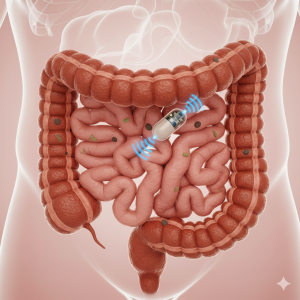
The process works by injecting microbubbles into the bloodstream. The focused ultrasound produced by the device causes the implosive collapse of the bubbles, which exerts pressure on the endothelial cells. This pressure forces apart the tight junctions between the cells allowing reagents to pass through; in this case, the penetration of albumin-bound paclitaxel (ranging from 40 to 260 mg/m2) into the brain. They found there was 3.7 times more paclitaxel in the brain with the use of the device. The investigators’ analyses also showed that the barrier’s integrity is mostly restored within an hour after using the device.
Not so fast
This is risky; opening the BBB is controversial and often one of the earliest detectable signs of neurodegenerative damage. The BBB’s major role is to protect the brain and the risks associated with opening it must be weighed against the possible benefits, even in extreme cases like the treatment of glioblastoma. The researchers did not see dose-limiting toxicity at dose levels up to 215 mg/m2, but at a dose of 260 mg/m2 they observed a grade 3 encephalopathy in one of 12 patients during the first cycle and a grade 2 encephalopathy in one patient during the second cycle.
All patients experienced disease progression and by the time of data cut-off, 10 of the 17 patients died. A post-hoc descriptive analysis reported median progression-free survival and overall survival as 2.9 months and 11 months, respectively.
Why does it matter?
Glioblastoma is considered one of the most aggressive and lethal types of cancer; these brain tumours are highly malignant, have rapid growth, and the aggressive infiltration of surrounding tissue leads to a bleak prognosis for patients.
The authors point out that paclitaxel is approximately 1,400 times more potent than temozolomide (the standard chemotherapeutic agent used in the treatment of gliomas), though unlike temozolomide, paclitaxel does not cross the blood-brain barrier.
The investigators’ analyses also showed that the integrity of the barrier is mostly restored within an hour after opening. This could be exciting news in the treatment of brain diseases if the BBB can be bypassed to allow delivery of targeted therapeutic agents.
Take home messages
1. The first in-human phase 1 trial of a skull-implantable ultrasound device which can demonstrate safe delivery of therapeutic agents to the brain.
2. A more than 3.5-fold increase in the dose of paclitaxel that crossed the BBB was observed.
3. Results indicate the possibility for effective treatment of an organ that has to date been an unreachable target for many therapeutics.
Guest Author: Conor McQuaid, PhD
This article was written as part of a series of ‘journal club’ summaries for Scientific Writers Ltd., and is based on the following publication.
First Author: Adam M Sonabend, et al.
Journal: The Lancet Oncology
Date online: 2 May 2023
Other references:
https://www.ncbi.nlm.nih.gov/pmc/articles/PMC9139611/
https://www.medpagetoday.com/hematologyoncology/braincancer/104325
We appreciate you taking the time to read and subscribe and allowing us to send informative articles your way.